
Hydrogen storage
In the future energy system, we will increasingly use green electricity. But renewable gases remain indispensable as feedstock and for specific processes.
Hydrogen storage is indispensable in a sustainable energy system
Hydrogen produced from renewable sources such as solar and wind will play an increasingly important role. Besides being a renewable fuel and feedstock, hydrogen will also be the energy carrier that provides electricity at times when solar and wind energy are unavailable.
Since the demand and supply of hydrogen do not match, it is necessary to store large quantities of hydrogen. This provides flexibility in the hydrogen market and ensures that sufficient hydrogen is always available, both for the short and medium term.
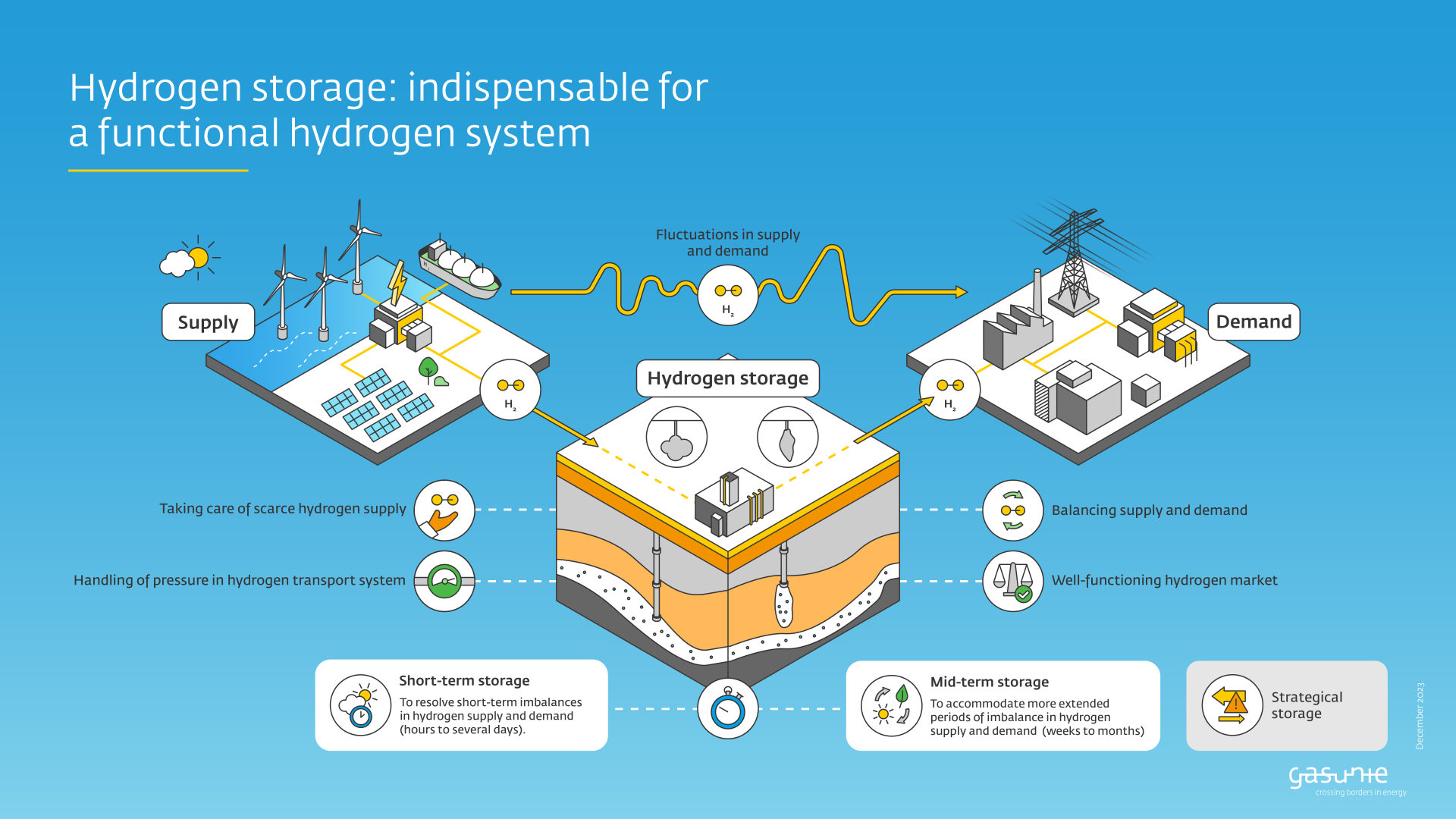
Storing hydrogen in salt caverns is safe, cost-efficient and flexible
Underground hydrogen storage in caverns is a safe, efficient and reliable way to store large amounts of energy for short or long periods of time. In the United States and England, hydrogen is already stored in salt caverns. The Netherlands and northern Germany also have salt domes in which caverns can be made. Natural gas has been stored in these for more than 10 years.
Zuidwending suitable for hydrogen storage and expertise available
Zuidwending offers unique conditions to store hydrogen. The required storage capacity will be developed in steps, starting with a first cavern in 2029 and then expanding to four caverns soon after 2030.
Gasunie has the necessary expertise in underground storage. Natural gas has been safely stored in the salt caverns in Zuidwending by Gasunie subsidiary EnergyStock for more than a decade. Gasunie now wants to use that expertise to store hydrogen in salt caverns.
Hydrogen storage demonstration project A8
In 2021, Gasunie started a pilot project in an existing well to demonstrate that hydrogen storage is safely and reliably possible in the Zuidwending salt caverns. In this project, Gasunie has mapped the effect of what the effects of hydrogen might be on equipment, material, cement and the salt wall.