
How will our ammonia terminal contribute to the energy transition?
News article
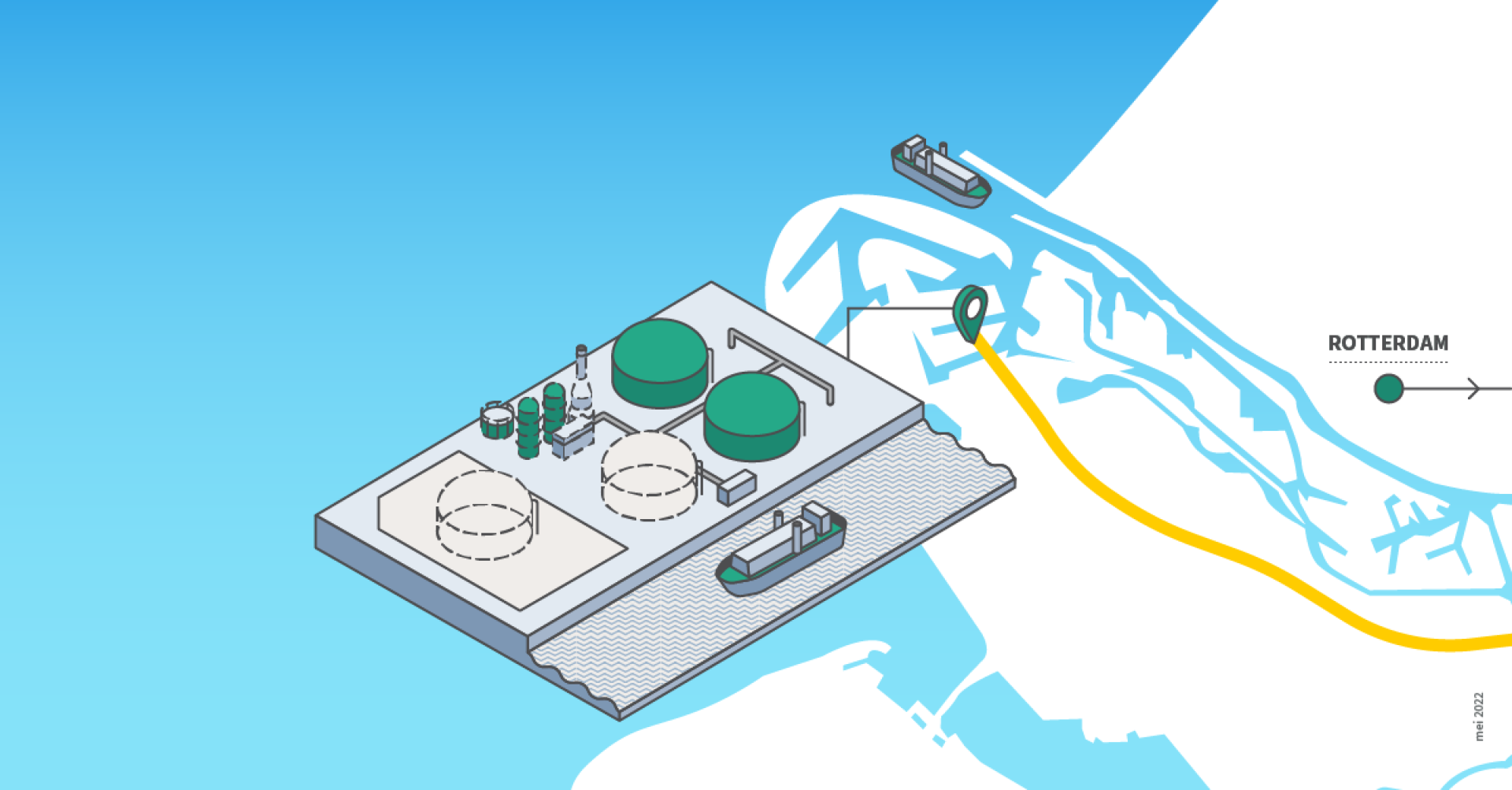
Ammonia, which consists of hydrogen and nitrogen, is easier to transport than hydrogen, especially over long distances. Because hydrogen will play a key role in our future energy system, Gasunie is developing an import terminal for ammonia, the ACE Terminal. We are working together with Vopak and HES International to realise this terminal in the Maasvlakte area of the Port of Rotterdam. Hydrogen import business developer Joost de Ruijter explains: ‘The idea of using ammonia as a hydrogen carrier is gaining momentum. By developing the ACE Terminal now we will soon be able to make a significant contribution to the energy transition.’
Making hydrogen transportable
Green hydrogen, that’s to say hydrogen made with green electricity, provides flexibility: depending on the supply and demand, we can use it directly as a fuel or feedstock, store it to use later, or convert it into green electricity. ‘However, hydrogen has a low energy density under atmospheric pressure and at atmospheric temperature,’ explains Joost. ‘You then need a lot of storage capacity for relatively little hydrogen, which is not convenient for transport over long distances. There are ways to transport hydrogen more efficiently, like by cooling it to an extremely low temperature so that it becomes liquid. This makes it considerably more dense, taking up less space. Or you can bind the hydrogen to liquid organic hydrogen carriers (LOHC). At the moment, however, we see that the most attention is being paid to the variant where hydrogen and nitrogen are combined to form ammonia.’

Converting existing assets
‘An additional advantage of ammonia as a hydrogen carrier is that the ammonia trade already exists. Infrastructure and regulations are already largely in place.’ Even the storage tanks are already there. Gasunie will be using its peak shaver (short-term LNG storage) facilities already in place at its Maasvlakte location. The two huge tanks can currently store 78 million cubic metres of LNG. Joost explains, ‘We are aiming to make the tanks suitable for the storage of ammonia with relatively limited adjustments. That is faster and more sustainable than building a completely new facility. Access to the site of our 'neighbour' HES International gives us quayside capacity for larger seagoing vessels and extra space for future expansion. And our other partner Vopak already has several ammonia terminals located all over the world and so has a great deal of knowledge about the technology and the market. This combination of partners is pure gold!’
Global ammonia trade
‘Together we want to become the ammonia import terminal of Rotterdam,’ Joost continues. ‘We are now in talks with parties that are looking at producing ammonia using green hydrogen. These are parties from all over the world, from Chile to Namibia, from Australia to Saudi Arabia, anywhere with a lot of sun and/or wind and plenty of space for energy farms. The ammonia is transported here on tankers, which will eventually operate on green fuel. Green ammonia will initially be of interest in particular to markets that now use grey ammonia made from natural gas, like the fertilizer industry for example. But the ultimate goal is that we will 'crack’, that’s to say break down, the ammonia into hydrogen and nitrogen again. The hydrogen can then be fed into the energy system over our hydrogen network.’
Contribution to the climate goals
The Netherlands can generate a lot of green energy on its own, but not enough. To achieve the climate goals we need other countries. Joost: ‘We will soon be harvesting solar and wind energy in places where there is an abundance of renewable energy and transporting it to places where there is not enough. Infrastructure is needed for this and that is exactly what Gasunie is good at. That is our role and our contribution. “But doesn’t this make us even more dependent on other countries?” you may ask. On the contrary. The situation with Russia has made us aware of our dependence. Because hydrogen comes from many different countries, you are not dependent on any one country or any one regime.’
Getting down to work
‘We have the ambition to use our existing LNG tanks for the storage of ammonia. We will start on the basic terminal design as soon as we have customer commitment. That’s what we’re working on right now. At the beginning of May, for example, we were at World Hydrogen 2022 in Rotterdam. This summit and exhibition was completely sold out. There we spoke with many interesting parties; it is clear that hydrogen and the potential of ammonia are hot topics. If all goes well, the ACE Terminal will be operational in 2026. And that’s just the beginning: additional tanks, transshipment facility, a cracking plant ... the terminal has the potential to develop into a world-class hub.’