WarmtelinQ starts work on Rijswijk–Leiden heat transport network
News article
WarmtelinQ has started work on the heat transport network between Rijswijk and Leiden this month. This route is an integral part of the pipeline that will run from the port of Rotterdam to The Hague and on to Leiden.
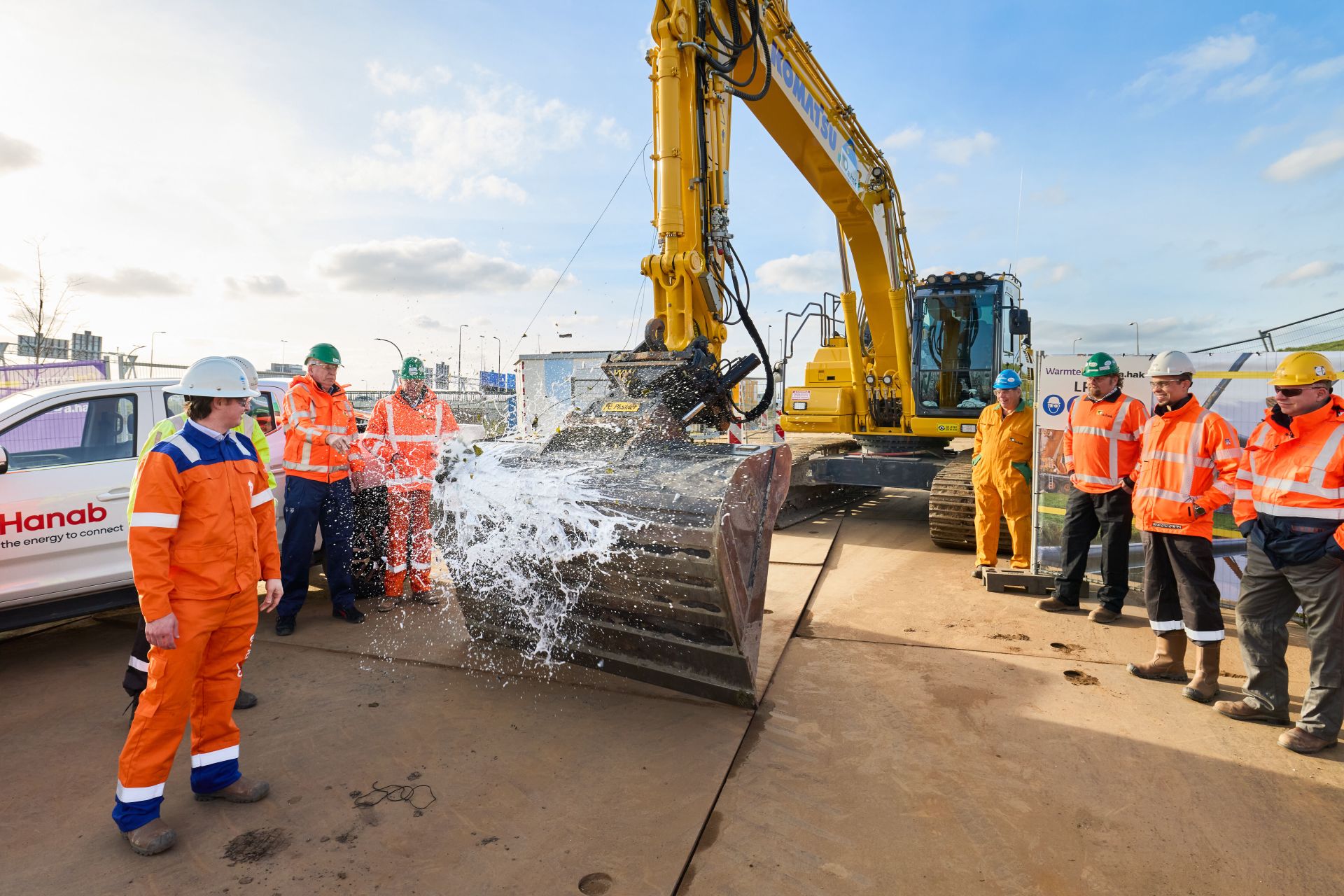
With the christening of the first construction crane to be used for this project, Heat Transport Director Inge Aardse and WarmtelinQ Project Director Gerard Minten, along with directors of the two contractors involved, A.Hak and Hanab, officially kicked off the project on Thursday 12 March.
Sustainable energy supply
The WarmtelinQ heat transport network will offer a sustainable solution by using waste heat from industry based in the port of Rotterdam to heat homes and businesses, giving heat that would otherwise have dissipated a second life. WarmtelinQ will supply heat to around 50,000 households and businesses across the region around Rijswijk and Leiden.
'With the Rijswijk–Leiden route, WarmtelinQ will be making an essential contribution to the heat transition and the energy system in the province of Zuid-Holland. The work we’re doing is of tremendous value for the future of the sustainable energy supply in this part of the Netherlands,' says Inge Aardse.
Construction
Over the coming years, we will be laying a total of 25 kilometres of underground pipeline for the Rijswijk–Leiden route. The associated works are expected to be completed in late 2028.
From the start of this month, WarmtelinQ has been working at five sites along the Rijswijk–Leiden route, with work at further sites of this section scheduled to start later. The five sites where work is now underway are the following: Wilhelminapark in Rijswijk, along the A4 motorway near Zoeterwoude, the Bosweide district in The Hague, the Forepark business park in The Hague, and the Stevenshof district in Leiden.
For more information about the works, see here.
Methods of construction
When it is completed, the WarmtelinQ heat transport network will run from the port of Rotterdam to The Hague and on to the city of Leiden. Most of the pipeline between the Vondelingenplaat industrial area and the city of The Hague is already in place.
This next step will see pipelines, both a supply and a return pipeline, being constructed between Rijswijk and Leiden using three different methods. Each of the three methods will take archaeological finds into consideration. The methods are the following:
- boring underneath the A12, A13, A4, A44 motorways, various waterways, and railway lines to minimise disruptions to traffic and inconvenience for local communities
- ploughing, especially in marshy areas along the A4 motorway
- digging trenches, laying pipelines and backfilling the trenches to restore the terrain to its original state
One of the most notable elements of the new stretch of pipeline is a 1562-metre bore, which will be the longest of the entire WarmtelinQ project.
Contractors thrilled
Peter Veermeer, Director of Pipeline Construction and International Operations at A.Hak: 'WarmtelinQ is a special and complex project, right in the heart of a busy environment with a great number of technical and logistical challenges. It is precisely the combination of factors involved, ranging from underground conditions to limited space and having to coordinate with numerous external parties, that makes this a project where expertise, collaboration and flexibility come together.'
Guus de Vries, Managing Director at Hanab: 'For us at Hanab, this is an exceptional project. Not only is it a large-scale project, but it also involves constantly changing work environments for us, as we move from urban areas full of underground cables, pipelines and traffic to open fields where we don’t know what we’ll encounter below the surface. This diversity of conditions requires a high level of expertise and close collaboration with all parties and stakeholders.'
Learn more
Everyone can track the progress of the works on the WarmtelinQ website and in the free BouwApp construction app (search for ‘WarmtelinQ Rijswijk–Leiden’) for facts and figures, the latest updates and details of disruptions and diversions.