
Our offshore activities
The North Sea is playing an increasingly larger role in making the Dutch energy supply more sustainable. The Dutch Climate Agreement contains commitments to reduce CO2 emissions and combat climate change. Wind energy is an effective way of achieving this, but it requires a great deal of space. That is why many wind farms are offshore.
The electricity generated there is brought ashore via cables. But this is becoming increasingly difficult due to the costs, the space the cables require and the limited capacity of the onshore electricity grid. What’s more, the energy must always be available, even when the sun is not shining and the wind is not blowing. Hydrogen can play a role here.
The role of hydrogen
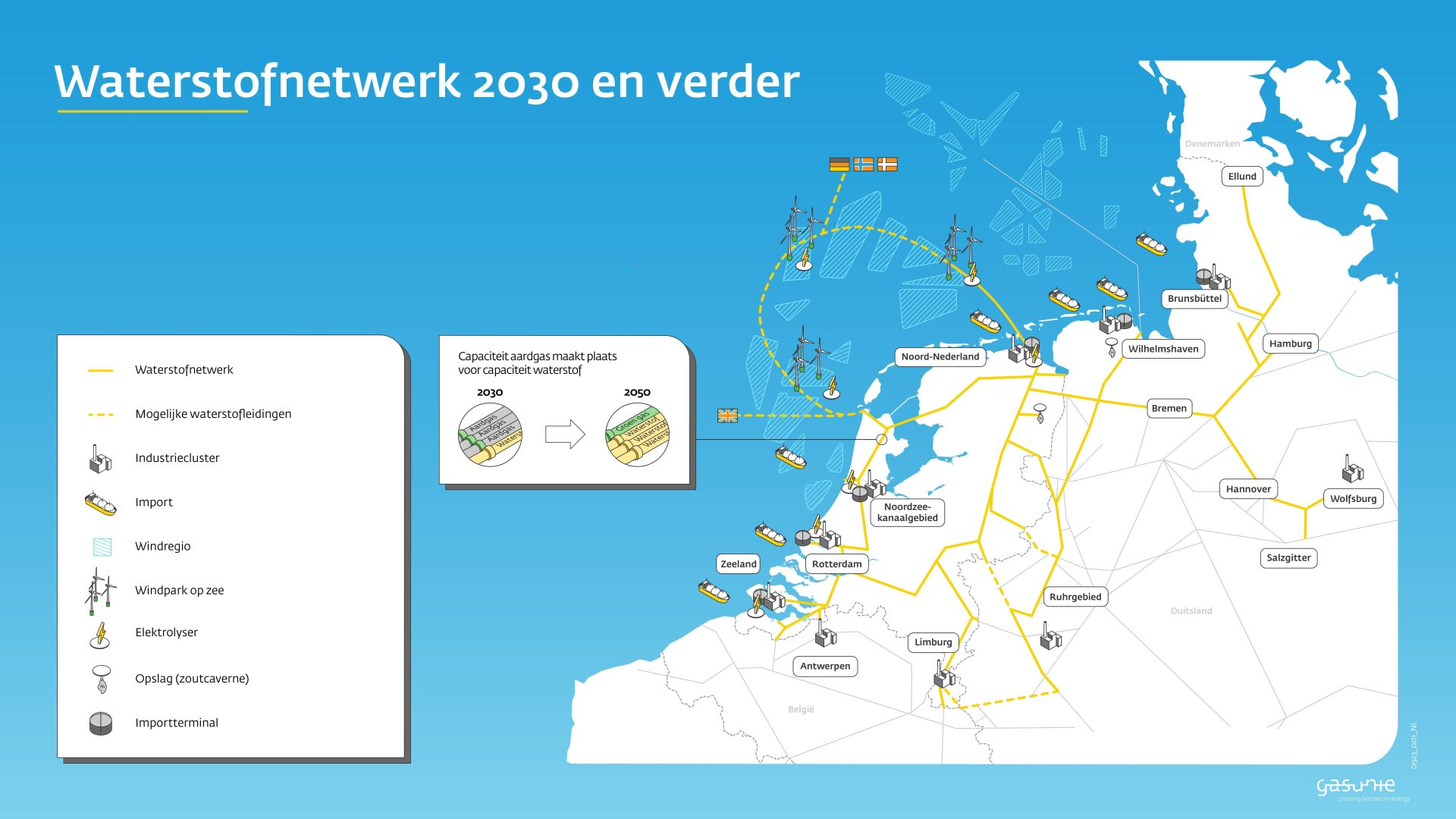
Green hydrogen can be produced offshore using wind energy and then transported to land via new and existing pipelines. This is less expensive than laying more cables, and less energy is lost because wind turbines do not need to be shut down as quickly when the wind is too strong. In addition, hydrogen can be stored for use when electricity is unavailable.
The transport of both wind energy and hydrogen to the mainland must contribute to achieving the climate targets set by the Netherlands. The Dutch government is aiming for a minimum offshore wind energy capacity of 30 GW by around 2040. Options for developing 40 GW of offshore wind energy are also being investigated. This would mean that the production of offshore hydrogen and the export of both electricity and hydrogen would once again play a role.
Gasunie’s role
Just as on land, Gasunie will be responsible for the transport of offshore hydrogen and the associated infrastructure. Although the Dutch government has temporarily paused preparations for offshore hydrogen production, Gasunie is still preparing for the next phase.
Hydrogen requires new connections, infrastructure and partnerships. That is why we are working on various studies, programmes and exploratory projects in the North Sea. International collaborations are becoming increasingly important in this regard.
HyOne: offshore hydrogen infrastructure
When we talk about HyOne at Gasunie, we mean the future offshore hydrogen infrastructure. To make this infrastructure a reality, various studies and programmes are currently underway, such as VAWOZ, PAWOZ, energy hubs, Demo 1 and Demo 2. We explain more about them below.
VAWOZ: bringing offshore energy to the mainland
The energy generated by future offshore wind farms must be brought ashore, so the Ministry of Economic Affairs and Climate Policy is investigating how and where these connections can best be established. This is being done through the Offshore Wind Landfall Foresight Study (VAWOZ in Dutch). Gasunie and TenneT are partners in this programme.
VAWOZ is investigating possible cable and pipeline routes in the North Sea and locations where these connections can make landfall. This involves various regions in the Netherlands, such as North Holland, South Holland, North Brabant and Zeeland.
VAWOZ started in 2023 and is expected to conclude in 2026.
PAWOZ: connecting energy to the mainland
Since energy generated offshore must be connected to the onshore power grid, the Ministry of Climate Policy and Green Growth investigated the options for cable and pipeline routes. This was done as part of the Eemshaven Offshore Wind Energy Connection Programme (PAWOZ in Dutch). Gasunie and TenneT were also partners in this project.
The routes investigated run from wind farms in the North Sea, via the Wadden Sea, to the mainland. There, the cable and pipeline routes connect to the national high-voltage power grid and to Hydrogen Network Netherlands.
Energy hubs: connecting energy
Energy hubs are large-scale wind farms from which energy can be brought ashore both as electricity and in the form of hydrogen. In the future, these hubs could also facilitate international connections across the North Sea.
Together with TenneT and the Dutch government, Gasunie investigated what these systems might look like and how they could be integrated within the spatial and ecological context of the North Sea.
We looked at ways to collect, convert and transport offshore energy, including international electricity connections and the conversion of electricity to hydrogen offshore. In doing so, Gasunie was building on the North Sea Wind Power Hub (NSWPH) programme.
Demo 1 & Demo 2: gaining knowledge and experience
The roll-out of offshore hydrogen is still in its early stages. Two demonstration projects have been announced: Demo 1 and Demo 2. These projects are designed to gain knowledge and experience relating to offshore hydrogen production and transport.
However, the national government has temporarily paused preparations for offshore hydrogen production and transport. As a result, no demonstration projects will be launched in the next five years, and no new offshore hydrogen infrastructure will be built.
Gasunie remains the intended network operator for hydrogen transport. We will therefore continue to carry out preparatory work, such as research into the reuse of existing infrastructure and the retention of knowledge. This will enable us to respond swiftly to new government decisions.