
Gas storage and strategic reserves: how can we make our energy system more resilient?
News article
This year, gas storage sites in the Netherlands are being filled up more slowly than usual. At the same time, the discussion about strategic reserves and the role they play in our energy supply is gaining momentum. What is the difference between gas storage and strategic reserves? And who is responsible for what? Jeroen Zanting, Managing Director of Gasunie Transport Services (GTS), explains how the system works and why he believes the Netherlands should be better prepared for prolonged disruptions.

What exactly is GTS's task within the gas supply system for the Netherlands, and what is explicitly excluded?
“GTS is a full subsidiary of Gasunie and has been appointed by the government as the national transmission system operator. Just like TenneT is responsible for the high-voltage power grid, GTS manages the national natural gas transmission network.
This makes GTS the link between supply and demand. Gas enters our network from small Dutch fields (onshore gas extraction and offshore extraction in the North Sea), pipelines from countries like Norway, LNG terminals for liquefied gas and, of course, gas storage facilities. We transport this gas to major industrial consumers, power stations, the connections to Germany, Belgium and the United Kingdom, and the regional Transmission System Operators (TSOs) who take the gas from our main network into people’s homes.
Over a period of 60 years, we have built up a flexible system that can handle a fluctuating supply of gas from all over the world very well. We make sure that the quality differences between these gases don’t affect our supply. If required, we treat the gas to ensure that end users always get the same quality. Our availability is extremely high, with only minimal service interruptions. We are doing our utmost to keep it that way.
This is what our work actually involves, but it’s equally important to explain what we don’t do, because that’s often misunderstood. GTS itself doesn’t extract any gas, doesn’t trade in gas, doesn’t own the large gas storage facilities and doesn’t fill those up either. We manage the network, the quality and the transport of gas. We also advise the government on security of supply.”
That advice on security of supply. How is that determined, and what does the government do with it?
“For our advice, we look at how much gas is required during a cold winter. Our scenarios assume that a key supply route could become unavailable. Would enough gas then be available for all users in the Netherlands and for transport to Germany, for example? We use the results of such a stress test to provide advice on how much gas should be stored in the Dutch storage facilities before winter sets in. We usually issue this advice at the start of autumn for the winter a year later. The Minister of Climate and Green Growth usually follows that advice.
This spring, we published a second advice about the resilience of the energy system, after noticing that the energy system is becoming increasingly vulnerable. We have seen sabotaging of pipelines and geopolitical tensions are increasing. Just look at how much LNG is stuck in the Strait of Hormuz. For this reason, we’ve also looked at what would happen if the supply of gas were to be interrupted for a longer period. Our conclusion is that the Netherlands is insufficiently prepared for this.”
Why have gas storage facilities and filling levels become more important in recent years?
“The most important reason for us to have gas storage facilities still are seasonal effects, as we use much less gas in summer than we do in winter. Because the supply of gas is generally constant, supplies for the winter are built up during the summer. These seasonal supplies have become more important, because we’ve become more and more dependent on gas imports. We don’t know in advance how severe a winter will be, but we do know that we need to prepare for this every year.
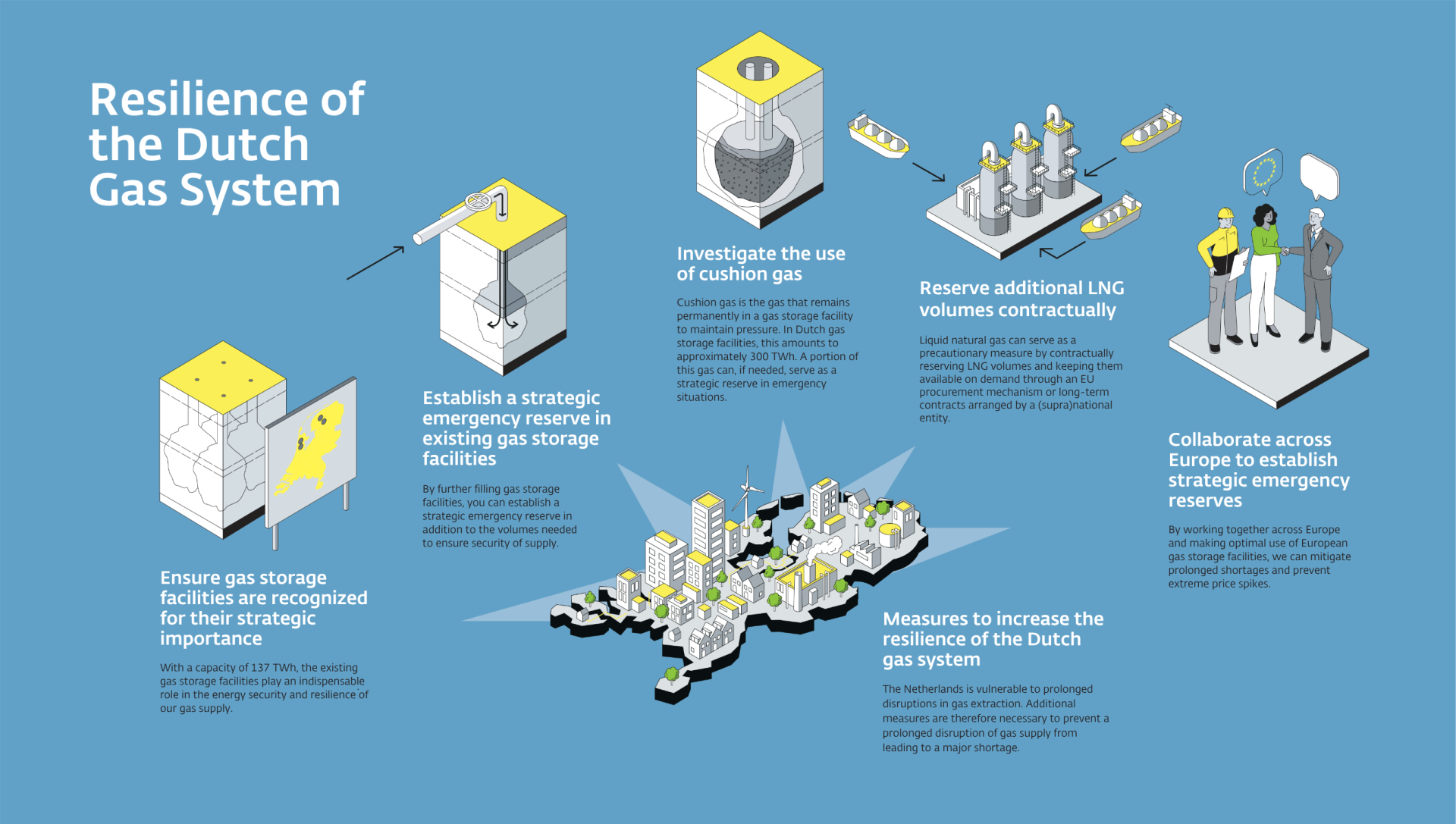
Other risks have emerged in recent years. Geopolitical tensions and military confrontations may lead to unforeseen and unpredictable disruptions to our gas supply. The seasonal storage facilities are not intended for this, which is why it is important to build up strategic reserves. You could say that, by now, we can see those geopolitical shocks coming. You just don’t know exactly where and when they will hit. In any case, it is sensible to have a buffer available, just in case.”
The filling levels of the seasonal storage facilities are lower than usual. What is the goal for the start of winter?
“It's variable, but filling levels are now lower than we’re used to historically. The goal for the coming winter is to have 115 TWh in storage, just under 12 billion cubic metres. This was included in the GTS advice issued last autumn.
Normally speaking, storage facilities are filled by market parties. This allows them to prepare for their winter supply obligation. You can do this by storing gas, but also by signing purchase agreements.”
Why has filling the facilities been so slow this year?
“Filling the facilities has been slow this year due to high prices and the fact that most of the usual price difference between summer and winter gas has disappeared. As a result, buying gas now for use in winter is currently unattractive for commercial parties.”
Is the filling level goal achievable?
“The Ministry has already taken an important step by asking Energie Beheer Nederland (EBN) to purchase gas for storage. When market parties drag their feet, it’s good that a wholly state-owned company such as EBN can step in to fill part of the gap. The rest needs to come from the market.”
Gasunie is calling for strategic gas reserves at existing storage facilities, preferably in a European context. Why is a European approach preferred?
“That's quite simple. Gas storage facilities are in fixed locations, this is geologically determined, and the Netherlands has a lot of gas storage capacity. Because of the excellent gas transport connections to the countries around us, these storage facilities fulfil a key function for the gas market in north-western Europe. This makes it logical to bear the costs together, as gas transport doesn’t stop at the border.
Strategic reserves ensure that we can absorb an unforeseen, prolonged supply disruption. Should anything happen, you’d want to keep everything running in Europe for about three months. The whole European system is now insufficiently prepared for this, so you’d have to organise a solution on a European level too.”
How does increased gas storage fit in with the energy transition? Wouldn’t increased gas reserves hinder the phase-out of gas?
“This is a complex issue. As we generate more and more energy with solar and wind, demand for gas drops, but also becomes more fickle. We hardly need gas during periods when there’s wind or sunshine. But without this, gas-fired power stations suddenly have to jump in and run at full power to supply electricity. These gas-fired power stations remain important for our energy supply.
That is why a system was recently introduced in the Netherlands where power stations receive compensation, because their operating hours may be dropping, but they do need to remain available.
Across the board, we are seeing that natural gas will remain necessary for longer than we previously expected. As long as this dependence exists, we’ll need to manage availability properly.”
Since the closure of the Groningen gas field, the Netherlands has been largely dependent on imports. How vulnerable does this make us, and what is GTS doing to keep the system resilient?
“That vulnerability does exist and will remain for the time being. We used to have a highly diverse system, with gas from Groningen, from Russia, from our own small fields, from Norway, and LNG from all over the world. Out of these, and apart from the diminishing supplies from the small Dutch fields, only two dominant sources remain: Norway and LNG from the United States. This makes the system less diverse and, consequently, more vulnerable.
Our network is well-prepared for a cold winter, but not that well for disruptions in the routes we still have available. We are constantly monitoring the situation and mapping out the risks. We carry out stress tests and advise the government. And if we notice that our resilience is inadequate, we put it on the agenda, like we did this spring.”
What developments and measures do you consider decisive in the coming years for safeguarding security of supply in the Netherlands?
“As far as I’m concerned, a strategic reserve would be decisive. I’m also looking at Norway. They’re investing a lot to keep gas production at this high level for longer, and we could sign multi-year contracts with the Norwegians. We want to have security of supply, and the Norwegians want to have security of demand. Let’s give each other this security. That would make the system stronger at both ends.
Finally, we must ensure that the transport tariff for the Dutch gas network remains affordable, so as to ensure that the Netherlands retains its hub position and remains attractive for market parties to supply gas to.”
What does Gasunie Transport Services do?
What we do:
Managing the national gas transmission system, monitoring and balancing the system, identifying geopolitical risks and advising the Minister of Climate and Green Growth on the security of gas supply.
What we don’t do:
Extracting gas, trading in gas, setting the price, owning large storage facilities or filling up storage facilities. The latter task is for market parties, or EBN in case of shortages. The Minister of Climate and Green Growth decides on this.