To enhance your experience, we use cookies. Cookies help us optimize the website and collect statistics.
You can adjust your cookie preferences by clicking on the 'Cookie preferences' button. Here you can specify which types of cookies you want to accept or reject.
To make the energy system and industry more sustainable, CO2-free gases such as green hydrogen are needed in addition to large amounts of renewable electricity.
To make the energy system and industry more sustainable, CO2-free gases such as green hydrogen are needed in addition to large amounts of renewable electricity.
This hydrogen, or hydrogen-based energy carriers, will be produced on a very large scale from variable renewable energy and imported from other countries and continents. Since the supply of and demand for CO2-free hydrogen are not synchronous, it is necessary to achieve sufficient flexibility, for example in underground hydrogen storage.
Salt caverns ideal for hydrogen storage
From a technical and economic point of view, storing hydrogen in salt caverns is the most promising solution, both for the long and short term. The buffering of hydrogen to balance production and consumption requires the injection and extraction of large quantities of hydrogen in a short period of time. Therefore, caverns are being realised, which are particularly well suited to supply hydrogen quickly. The caverns function as a lung in the hydrogen network and enable the overall energy system in the Netherlands and Europe to achieve the ambitious sustainability goals.
Potential in the northern Netherlands
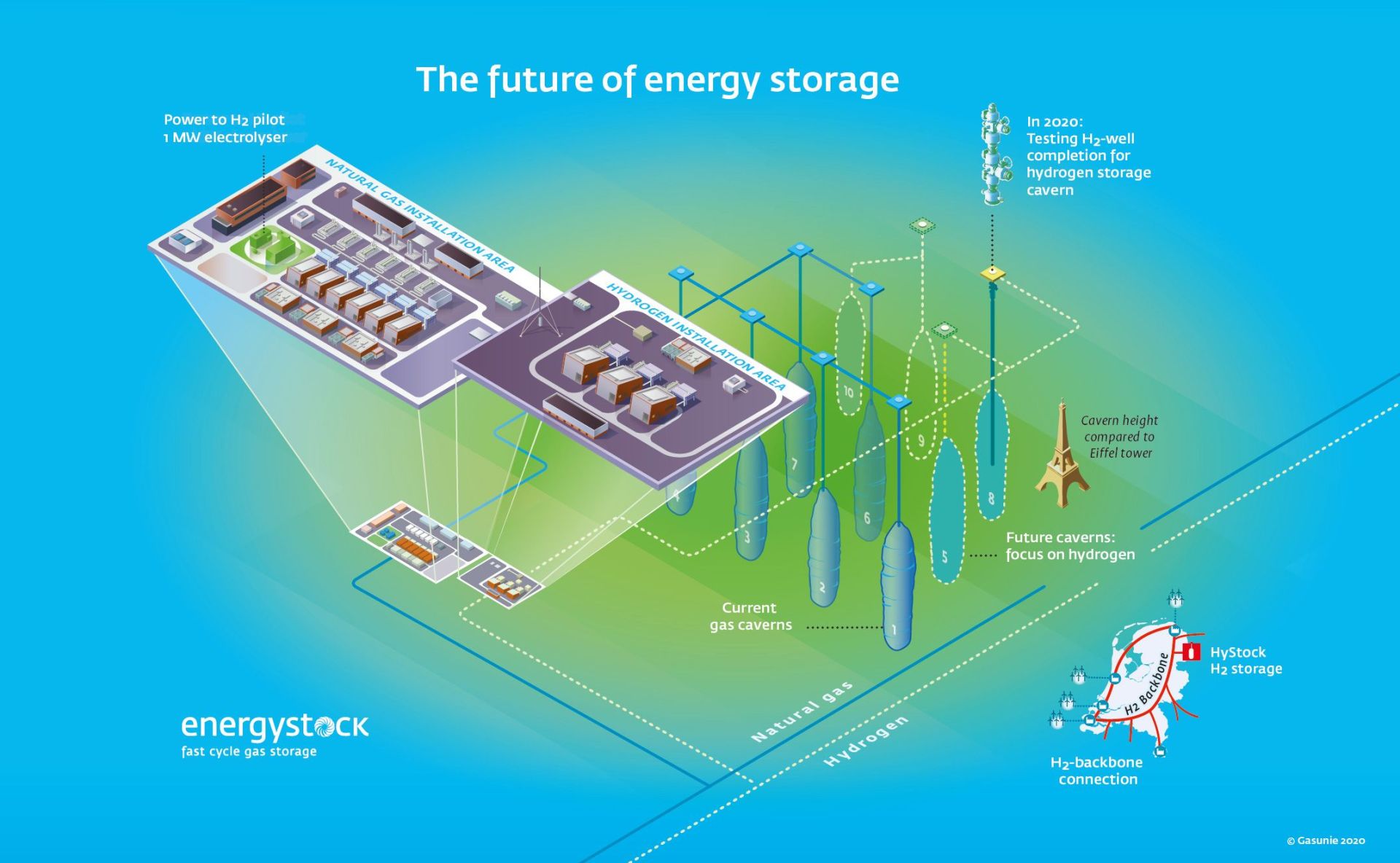
The area in the northern Netherlands has the ideal subsoil for realising salt caverns. In Zuidwending, near Veendam in the province of Groningen, EnergyStock already stores natural gas in six caverns. Gasunie plans to develop the first large-scale hydrogen storage at this location. In total, 4 hydrogen caverns will be developed here with a total storage capacity of 20 ktonnes of hydrogen.
The site at Zuidwending is also particularly suitable because it is located near the natural gas network. Part of the natural gas network will be converted into a national hydrogen network in the coming years.
Schedule
The feasibility study was carried out in 2020. In 2023, after a whole series of tests, it was found that hydrogen storage in a cavern is safe.
In 2023, the first cavern (A5) will reach its final shape and size. Once the necessary permits are obtained, construction of the above-ground plant and preparations for hydrogen storage will start. If all goes according to plan, the first hydrogen cavern will be ready for operation around 2031.
No cookie consent given for: Remarketing (YouTube
)
Would you like to find out more about this project?
Gasunie would like to talk to you as a potential user of the hydrogen storage system.
Gasunie and Nobian take next step for HyStock hydrogen storage facility
Date
Last Thursday 13 February, Executive Board member of Gasunie Hans Coenen and Philipp Polenz, COO of Nobian, sealed with their signatures the next step in mutual cooperation for the successful and safe realization of the underground hydrogen storage facility at Zuidwending.
As part of the national hydrogen infrastructure, Gasunie subsidiary EnergyStock is preparing four salt caverns for hydrogen storage over the next few years. The first of these will be ready around 2031; the next three will first be developed by Nobian before EnergyStock can make them suitable for hydrogen storage. Nobian and EnergyStock have been working together on this HyStock project for some time. So-called evaluation drilling allows Nobian to determine the exact composition of the salt so that we can be sure whether it is suitable for hydrogen storage.
The moment of signing follows after the final decisions for the permits for the evaluation and deep drilling at Zuidwending have been published by the Ministry of Climate and Green Growth and the objection period has expired. Now the ordering of materials and the planning and execution of the drilling can begin.
Successful Open Season: ample interest in hydrogen storage first salt cavern HyStock
Date
Several market players reserved capacity in the first salt cavern for large-scale hydrogen storage at Zuidwending in Groningen during HyStock's Open Season. The requested reservations far outbid the offered storage capacity of 216 GWh. An auction will allocate the available capacity fairly and transparently to these market players. With this wide interest, this Open Season, which ran from 15 June to 14 July, can be called a success.
HyStock starts 'Open Season' for hydrogen storage
Date
HyStock develops for the market and makes investment decisions in line with market demand. To stay on track with the current planning, HyStock must make another investment decision soon. This decision requires commitment from the market.
HyStock intends to start the 'Open Season' and share all information about the process on June 15. The first results will be announced this summer.
Parties that want to participate but have not yet concluded a Non Disclosure Agreement with HyStock can contact info@hystock.nl.