
Hydrogen import
Hydrogen will play a very important role in the energy supply of the future. Especially in industry and heavy transport, hydrogen is an indispensable substitute for fossil energy. Among other things, it is used as a feedstock by refineries and fertiliser plants and as a fuel when high temperatures are needed for baking, drying and melting processes. Hydrogen is also important as a fuel for heavy transport.
Electrolysers and green energy
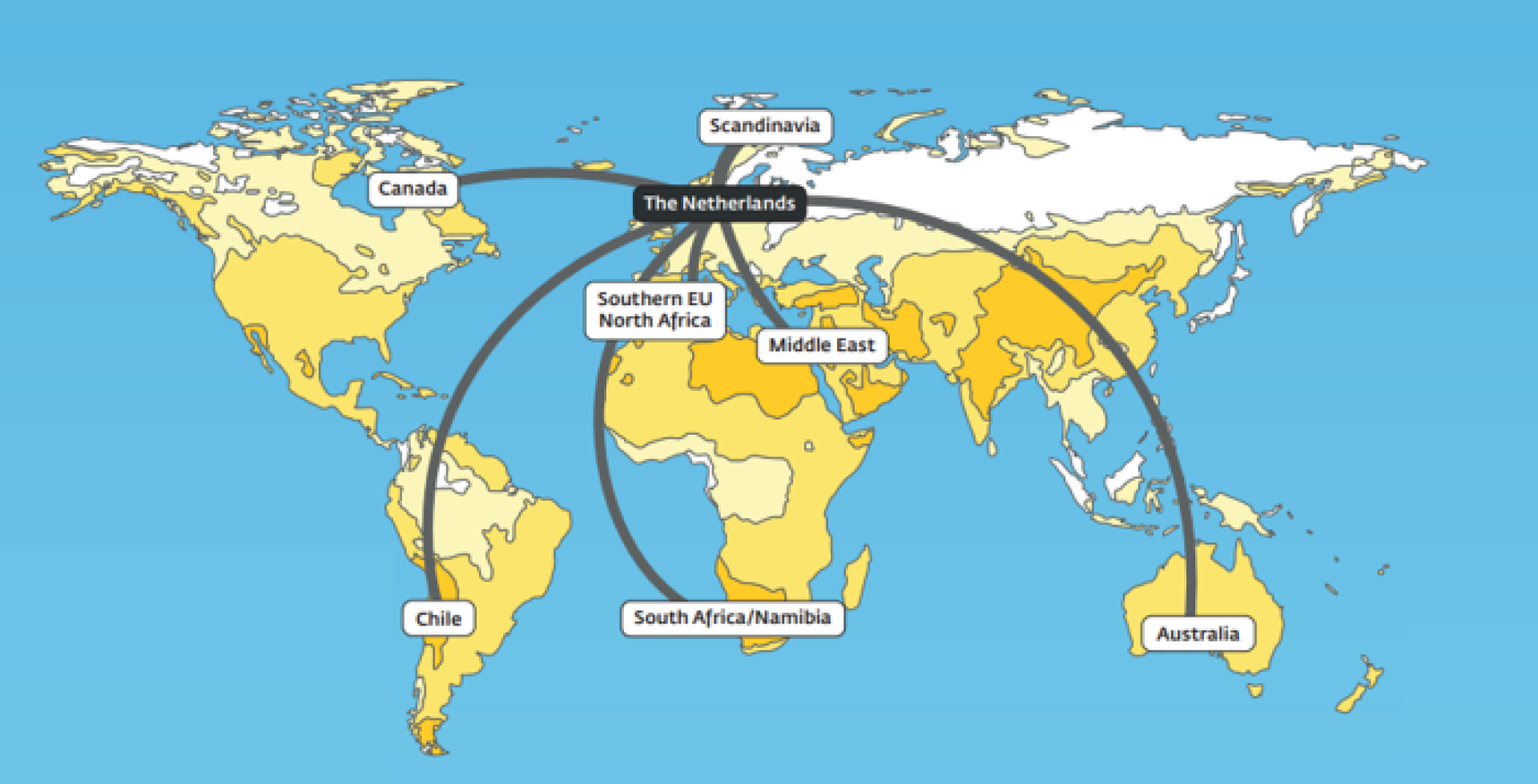
Making green hydrogen requires a lot of green electricity. Because hydrogen is made sustainably by using green electricity to split water into hydrogen and oxygen. There are concrete plans for several large wind farms in the North Sea, but this is insufficient to meet the large future demand for hydrogen. For this reason, plans are worked out to import hydrogen from areas where there is a lot of wind and/or sun, for example in southern Europe, the Middle East and countries like Chile, South Africa and Namibia.
Carriers for hydrogen
Hydrogen can be transported in different ways. The most obvious is transportation through pipelines. But if the distance increases, then ships are more obvious.

To transport hydrogen in liquid form in ships, you need to cool it extremely (down to -253 degrees). Another possibility is to transport hydrogen gaseously under high pressure (250 to 500 bars). Both alternatives cost a lot of energy. Another more obvious possibility to transport hydrogen over longer distances is to bind it with nitrogen, creating ammonia.
This method has been tried and tested, and ships already exist to transport ammonia around the world. On arrival at the port, hydrogen still needs to be separated from the nitrogen (cracking). Work on this technology is still in progress to eventually do this on a large scale.
Import harbors
Gasunie is making plans to build import infrastructure at ports where hydrogen carriers can come ashore. In addition, agreements are being made with many international players to channel import flows from the world to the Netherlands.
ACE Terminal
Gasunie, together with partner Vopak, is developing an import terminal for green ammonia in the port of Rotterdam, called ACE Terminal. The planned terminal is strategically located with direct access from the North Sea, connection to the Rotterdam industry and Gasunie's hydrogen infrastructure for transport and storage.