
Delta Rhine Corridor East
Project
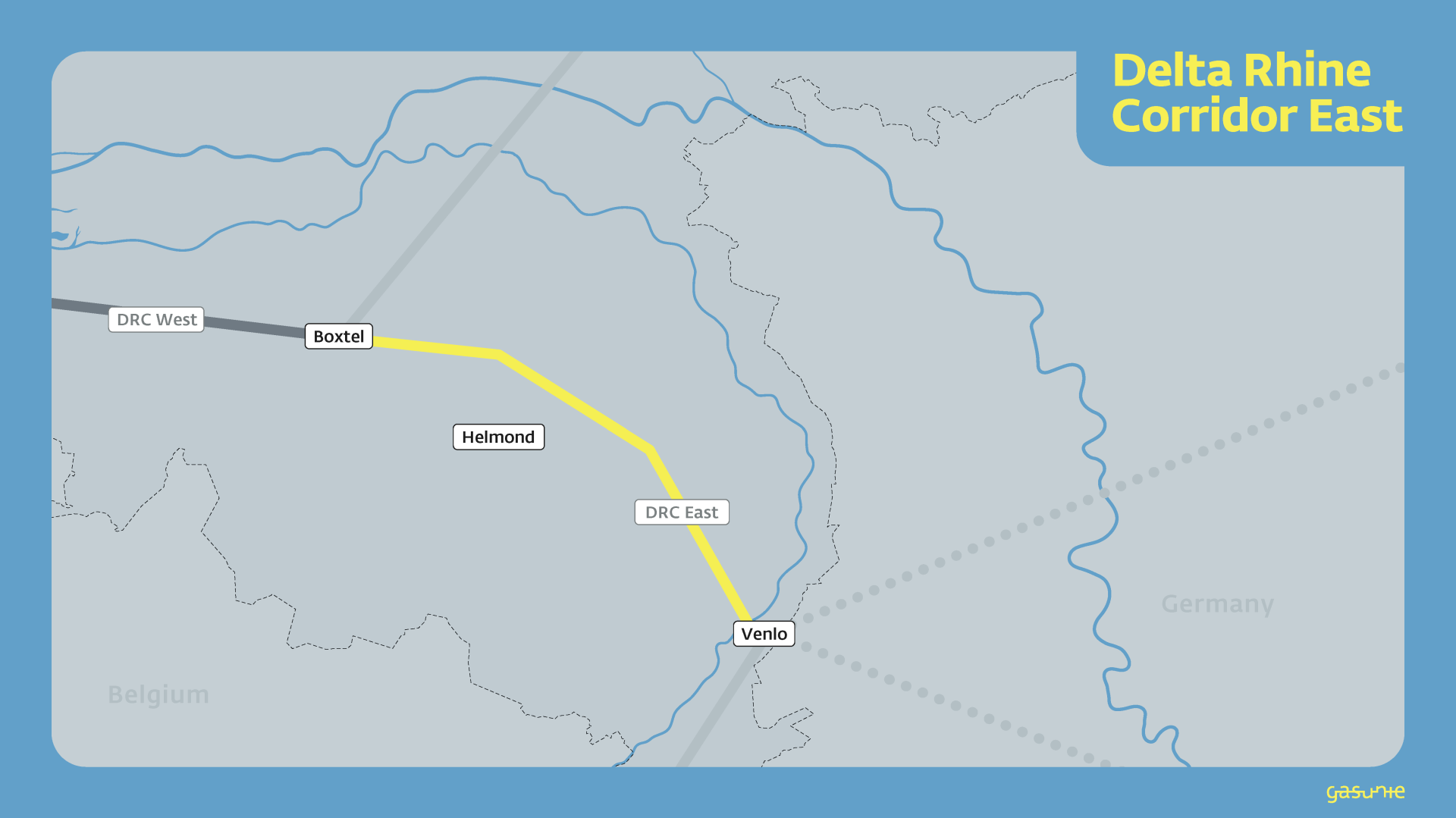
The Delta Rhine Corridor East is the initiative to construct a single pipeline, including all associated technical installations, from the German border near Venlo to Boxtel. This will be an underground CO2 transport pipeline.
On this page
The project in a nutshell
As the Netherlands has set out to cut carbon emissions by 55% by 2030 compared to the year 1990 and to be fully carbon neutral by 2050, we are working to decarbonise industry. After all, industry is responsible for a large part of the Netherlands’ carbon emissions. To be able to go sustainable, companies want to reduce these emissions. To help them with that, we are taking measures to capture CO2, transport it and store it safely.
CO₂ pipelines
DRC East concerns the construction of a single underground pipeline, including associated technical installations, to transport CO2 from the German border near Venlo to Boxtel. This pipeline from Venlo to Boxtel is expected to be built in 2032 and 2033. In Boxtel, DRC East will link up with DRC West.
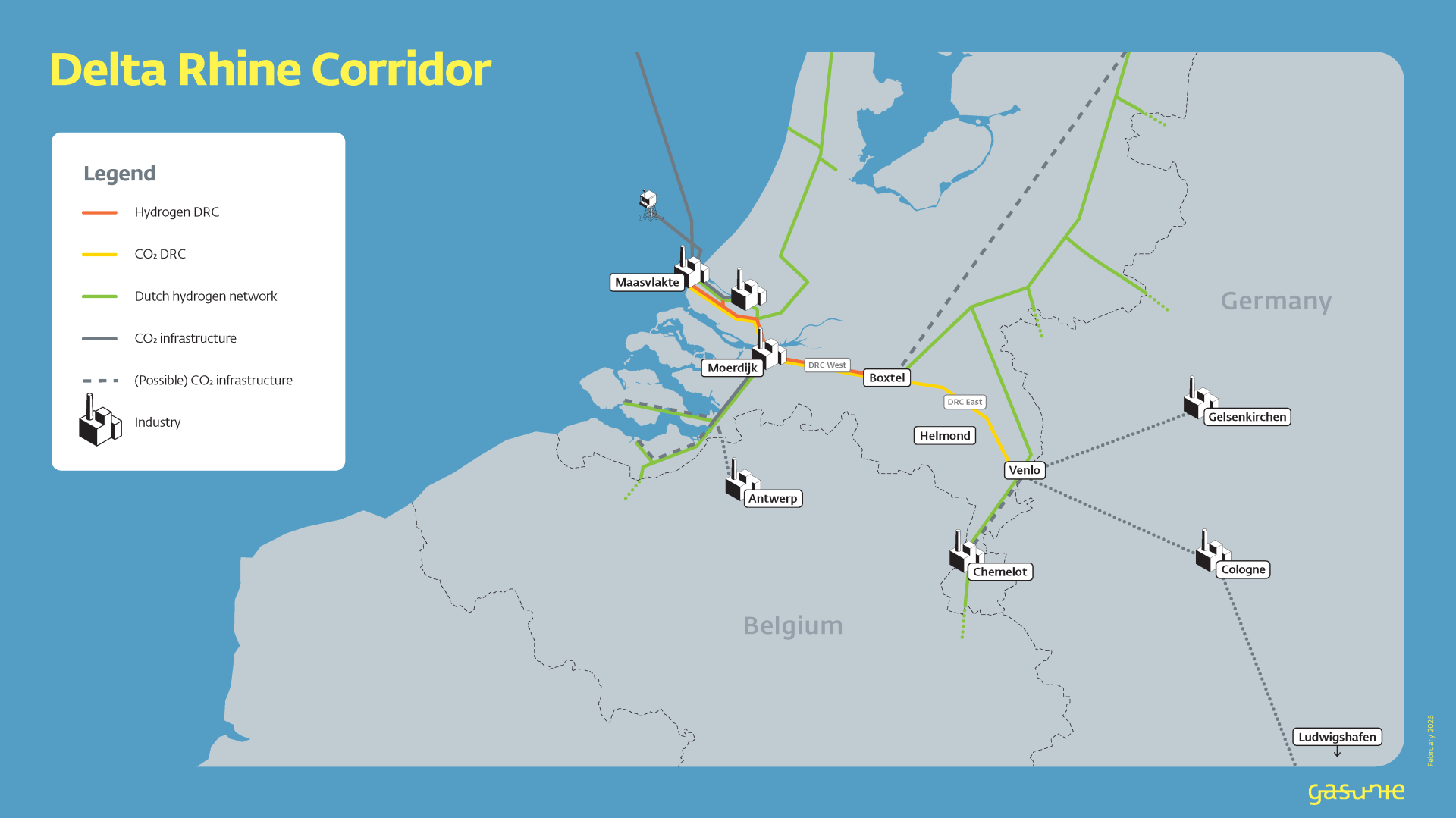
The CO2 pipeline in DRC West is being installed between Boxtel and Rotterdam (Maasvlakte industrial area), passing through Moerdijk. The Delta Schelde CO2nnection, a CO2 pipeline for transporting CO2 to the Belgian border, can be connected to DRC West at the Moerdijk location.
Together, DRC West and DRC East make up the Delta Rhine Corridor.
Where will the pipelines be located?
We are still looking into exactly where the DRC East pipelines will be located. The exact location of the pipelines and associated energy infrastructure will be decided at a later stage of the process based on the results of various studies that will be presented in the Memorandum on Scope and Level of Detail. The final location of the pipelines will be announced in the project decision.
What is clear at this stage, however, is that they will be located within a corridor known as the ‘PEH corridor’, which is the area the Dutch government has reserved for pipelines under its Main Energy Structure Programme (Programma Energiehoofdstructuur, or PEH). Roughly 70 metres wide, the PEH corridor runs from the Rotterdam port area to Moerdijk and on to the province of Limburg. See the project map for the exact location of this corridor.
You can read more about the Main Energy Structure Programme on the website of the Dutch Government.
Participation: plans submitted to local communities
On Friday 27 March 2026, the DRC East project procedure started with the publication of the Notification of Intention and Proposal for Participation, which is the initial announcement of the plans for DRC East. The Notification of Intention and Proposal for Participation document lays out the specifics of Gasunie’s mandate, Gasunie’s steps in the procedure of developing the plans and how Gasunie intends to involve local communities in the procedure.
Until Thursday 7 May 2026, everyone had the opportunity to submit a response to the Intention and Proposal for Participation (VenP). The State Secretary for Climate Policy and Green Growth is responsible for the procedure that must be followed. Gasunie is responsible for constructing the pipeline
An online meeting
Gasunie and the Ministry of Economic Affairs and Climate Policy organised a digital information meeting on Thursday 16 April. During this meeting, we briefly explained the plan and answered your question.
You can watch the meeting and view all questions that were submitted on Delta Rhine Corridor East | Energietransitie.nl. You can also find all information about the Project Procedure there.

Get updates
Sign inIf you’d like to stay in the know on the commercial (national and international) developments concerning the DRC CO2 network and the Delta Schelde Co2nnection, you can sign up for the various newsletters for industry on the Delta Rhine Corridor page.
Contact
For any queries, please write to drc@gasunie.nl or contact our project team:
More information
Contact Peter van Dijken

More information
Contact Johannes Andriessen

Frequently asked questions
-
The Ministry of Economic Affairs and Climate previously published a Notification of Intention and Proposal for Participation for the Delta Rhine Corridor in 2023. The plan at the time was to construct six pipelines and several underground direct current connections. In late 2024, the relevant ministers decided to develop the Delta Rhine Corridor only for hydrogen and CO2 pipelines. The project procedure was subsequently restarted and split up into DRC West (Maasvlakte–Boxtel: hydrogen and CO2) and DRC East (Boxtel–German border: CO2).
The project area for DRC East was also changed at that time. The branch from Chemelot to Reuver has been removed from the plan for now. Given that fewer pipelines and cables will be needed, the search area for a connection to the German network on the border near Venlo is now smaller.
Where relevant, feedback on the Notification of Intention and Proposal for Participation from 2023 will be taken into consideration in the next steps for the procedure.
-
The route for the pipelines is, for the most part, already known. This is because they will be laid in a pipeline corridor that has already been designated. Known as the ‘PEH corridor’, this is the area that the Dutch government has reserved for (future) underground pipelines under its Main Energy Structure Programme (Programma Energiehoofdstructuur, or PEH). On this webpage, you can see the routes of these pipeline corridors in the Netherlands.
In some locations along this PEH corridor we also already know that there is limited space to install the pipeline. Together with our colleagues who are designing the corridor, we are investigating what is possible and where we need to deviate from this pipeline corridor at certain locations. We will only deviate from the PEH corridor in areas where there is no room left in the corridor, where there are (technical or land-use) obstacles or where we need space to cross obstacles such as railways.
-
At present, we know too little about the exact route to engage with landowners about it. At a later stage, Gasunie will contact landowners whose land the pipelines may pass through.
-
The DRC East pipeline will link up with the CO2 network in Germany. We are currently looking into where exactly the pipeline can cross the border.
Wherever possible, the pipeline will run along the special corridor that the Dutch government has designated for underground pipelines (the ‘PEH corridor’). This corridor runs along the border for about 8 kilometres between the town of Reuver and the A74 motorway. This is where we are looking for an area with enough space for a single CO2 pipeline. We have identified several places where the pipeline could cross the border. Talks about these options with Gasunie’s German partner, OGE, are meanwhile underway.
In 2023, we were still looking at a larger area, because the project still included several pipelines and cables at the time. Since this is no longer the case, the area north of the A74 motorway has largely been excluded from the search scope. Only a small area along the A74 motorway is still being considered as an option.
-
Since there was too little market potential in carbon capture and transport from Chemelot to Reuver, this section has not been included in the DRC East project procedure.
-
Several Gasunie projects will either cross DRC East or partially run along the same route:
- The Delta Rhine Corridor West concerns the construction of pipelines to transport hydrogen and CO2 from Rotterdam to Moerdijk and on to Boxtel. DRC East will link up with DRC West at Boxtel.
- DRC East shares the middle part of its route, which passes through the municipalities of Horst aan de Maas, Peel en Maas, Beesel and Venlo, with a section of the Limburg hydrogen network.
- In the eastern part of the Netherlands, there are plans to repurpose an existing natural gas pipeline for hydrogen gas transmission. This pipeline is planned to run from Ommen to Boxtel, by way of Angerlo and Ravenstein. At Boxtel, the Eastern Netherlands Hydrogen Network will cross DRC East.