To enhance your experience, we use cookies. Cookies help us optimize the website and collect statistics.
You can adjust your cookie preferences by clicking on the 'Cookie preferences' button. Here you can specify which types of cookies you want to accept or reject.
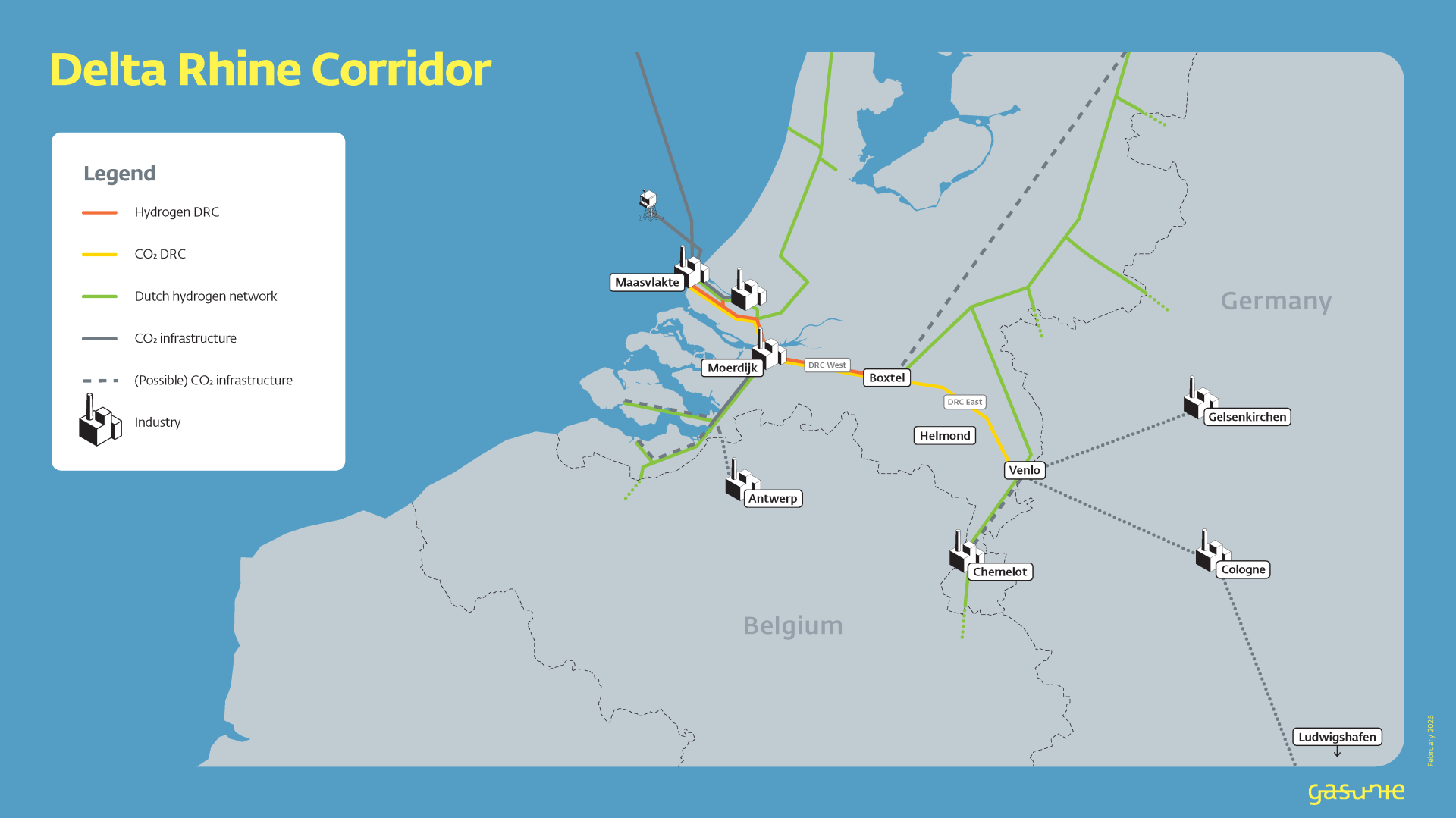
The Delta Rhine Corridor (DRC) project is an initiative to construct underground pipelines for the transport of hydrogen and CO2 between Rotterdam and the German border close to Venlo, by way of the industrial area in Moerdijk.
The Delta Rhine Corridor (DRC) project is an initiative to construct underground pipelines for the transport of hydrogen and CO2 between Rotterdam and the German border close to Venlo, by way of the industrial area in Moerdijk.
Laying pipelines for hydrogen and carbon dioxide (CO2) in a single corridor will help heavy industry in the Netherlands and Germany become more sustainable and will cut carbon emissions considerably. Furthermore, the DRC strengthens the strategic and economic position of the industrial areas in north-western Europe, in particular in the Netherlands and Germany, and the project will create a key connection between the Netherlands and Germany.
Pipelines for transporting hydrogen and CO₂
Hydrogen
The hydrogen pipeline will be constructed between Rotterdam and Boxtel, where it will connect to another part of the national hydrogen network, which also creates a connection to Germany and Limburg. This hydrogen pipeline, which is part of the national hydrogen network, is a key east-west connection that will make the hydrogen network an end-to-end, integrated network. You can read more about the hydrogen network and the possibilities to connect your company to the hydrogen pipeline in the Delta Rhine Corridor on the Hynetwork website.
CO2
The CO2 pipeline in the Delta Rhine Corridor is being installed between Rotterdam (the Maasvlakte industrial area) and Venlo, where the pipeline will connect to pipelines in Germany and this way also reach industry there. Another CO2 pipeline will be constructed from Rotterdam to Antwerp via the Dutch province of Zeeland, the Delta Schelde CO2nnection.
Where will the pipelines be located?
The exact route the Delta Rhine Corridor will follow is still being studied. What is clear, however, is that in the Netherlands the starting point is the ‘PEH’ corridor, the area the Dutch government has reserved for pipelines under its Critical Energy Infrastructure Programme. This corridor runs from the port area in Rotterdam via Moerdijk to the province of Limburg.
DRC West and DRC East
The plans for the Delta Rhine Corridor are being developed for two separate but connecting sections: DRC West and DRC East. Each section has a separate, dedicated project procedure.
All information about the Project Procedure can be found on the website of the Dutch Government. There, you can also view all documents related to the Project Procedure.
DRC West
Thema
Energy system
The exploratory phase for DRC West began in September 2025.
Subscribe to one or more of the newsletters on developments around the Delta Rhine Corridor and keep up to date on the hydrogen network and the CO2 network in the Netherlands, of which the DRC is a part.
DRC newsletters
For the local community
These newsletters are for anyone interested in the developments around the Delta Rhine Corridor and the steps in the project procedures. The DRC project is divided into two procedures, each independent of the other: DRC West and DRC East. You can subscribe to one or both newsletters.
Newsletter: DRC CO₂ network and Delta Schelde CO₂nnection
For industry
If you’d like to stay in the know on national and international developments around the construction of the CO2 pipelines in the DRC and the Delta Schelde CO2nnection line, you can sign up for our English newsletter written specifically for industry.
In this newsletter, Hynetwork, a fully owned subsidiary of Gasunie, shares news about the progress of and plans for the national hydrogen network. If you are interested in connecting to the hydrogen pipeline in the DRC or in any other matters relating to this project, you can find out more on the Hynetwork website.
Memorandum on the scope and level of detail adopted for Delta Rhine Corridor West
Date
The Memorandum on the scope and level of detail (NRD) for Delta Rhine Corridor West has been adopted. The memorandum sets out what will be assessed in the environmental impact assessment (EIA) and how these studies will be conducted. This marks an important step in the further development of the project.
Project procedure for the first part of the Delta Rhine Corridor underway
Date
Starting from 5 September, the notification of intention, the research plan and the participation plan for the first part of the DRC, DRC West (running from the Maasvlakte industrial area to Boxtel), will be available for inspection by local residents and businesses and other interested parties. This marks a new step in this vital project.
The Delta Rhine Corridor will focus on the construction of pipelines for hydrogen and CO2. Minister Sophie Hermans of the Ministry of Climate and Green Growth announced this in a parliamentary letter on 5 December 2024.
The Delta Rhine Corridor (DRC) project will focus on building the pipelines to transport hydrogen and CO2. This was announced by the Dutch Minister for Climate Policy and Green Growth Sophie Hermans in a letter to Parliament. This choice was made with the aim of achieving the objective of making industry more sustainable and meeting the targets under the Paris Climate Agreement.
Continuing a joint project procedure, but separate construction
Date
On 27 June 2024, the then climate and energy minister informed the House of Representatives regarding the planning of the Delta Rhine Corridor. The minister decided to continue the project in a joint project procedure.
The responses to the Proposed Intent and Proposal for Participation have been answered in the Response Note. This document has been published as of 26 Jan 2024. On the website of Bureau Energieprojecten, you can find the Intention and Proposal for Participation, the consultation bundle and the reaction note (in Dutch).
New scope of the Delta Rhine Corridor project
Date
On 5 October 2023, Dutch Minister for Climate and Energy Rob Jetten sent a letter to the Lower House of Parliament about progress in the Delta Rhine Corridor. This letter clarified the decisions taken on the scope of the project, safety, spatial issues along the DRC route, cooperation with Germany, the schedule and next steps. Read the Letter to parliament on progress in the Delta Rhine Corridor (in Dutch).
Gasunie remains the initiator of the procedure for the DRC on behalf of the other parties involved, including TenneT.
Online posters
Date
Several posters were displayed by the Ministry of Economic Affairs and Climate Policy and Gasunie during the information meetings in June 2023. You can download them below.
The announcement of the plan, the Intention and Proposal for Participation (VenP)
Date
The Delta Rhine Corridor project began with the announcement of the plan, the Intention and Proposal for Participation (VenP). Gasunie acted as initiator of the VenP on behalf of the Delta Rhine Corridor Partners. The VenP announced the project and explained the procedure and participation process.
Frequently asked questions
Frequently asked questions
Below are the most frequently asked questions and their answers. Is your question not listed? Then contact us using the form at the bottom of this page.
The Dutch government sees a number of challenges in the areas of climate, the economy, security of energy supply, and energy independence from other countries. The government is facing the following challenges:
Climate: the Netherlands must reduce its carbon emissions by at least 55% by 2030 compared to 1990. This can be achieved by switching to renewable energy, such as hydrogen. In addition, efforts are being made to capture and permanently store CO2 so that it does not end up in the atmosphere.
Energy: sustainability, security of supply and energy independence are essential for the Dutch energy system. Developments such as the Russian invasion of Ukraine play a role in this.
Economic value of industry: making business processes that currently use fossil feedstock and fuels more sustainable is essential for keeping the economic value of large industrial clusters in the Netherlands.
The pipelines in the Delta Rhine Corridor can provide a solution to these challenges. The construction of the Delta Rhine Corridor pipelines for hydrogen and CO2 can make the large industrial clusters like the North Sea Canal area and Rotterdam/Moerdijk in the Netherlands (as well as clusters in Germany) drastically more sustainable. This way, we protect the climate while also ensuring that we become less dependent on other countries. By connecting the Netherlands with Germany, the Delta Rhine Corridor will help bolster the strategic and economic position of the industrial areas in north-western Europe. The Delta Rhine Corridor will also reinforce the competitive position of the Port of Rotterdam as a hydrogen hub in north-western Europe.
The Dutch Minister of Climate Policy and Green Growth is, together with the Minister of Housing and Spatial Planning, the competent authority for decision-making on the spatial integration of the project. The Dutch Ministry of Climate Policy and Green Growth is responsible for coordinating the project procedure. As the authority responsible for policy on infrastructure (such as pipeline infrastructure), the Dutch Ministry of Infrastructure and Water Management is also involved.
Gasunie is the initiator for both the DRC West and DRC East project.
The provincial authorities for the provinces of Zuid-Holland, Noord-Brabant and Limburg are involved in their role as competent authorities, as are the municipal authorities and water boards in the project areas for DRC West and DRC East.
Media enquiries?
All media enquiries should be sent to Gasunie press officer Michiel Bal at m.t.bal@gasunie.nl. He can also be reached on +31 (0)6 1100 5849.