
InfraVision: infrastructure for our energy supply in 2030 and 2050
News article
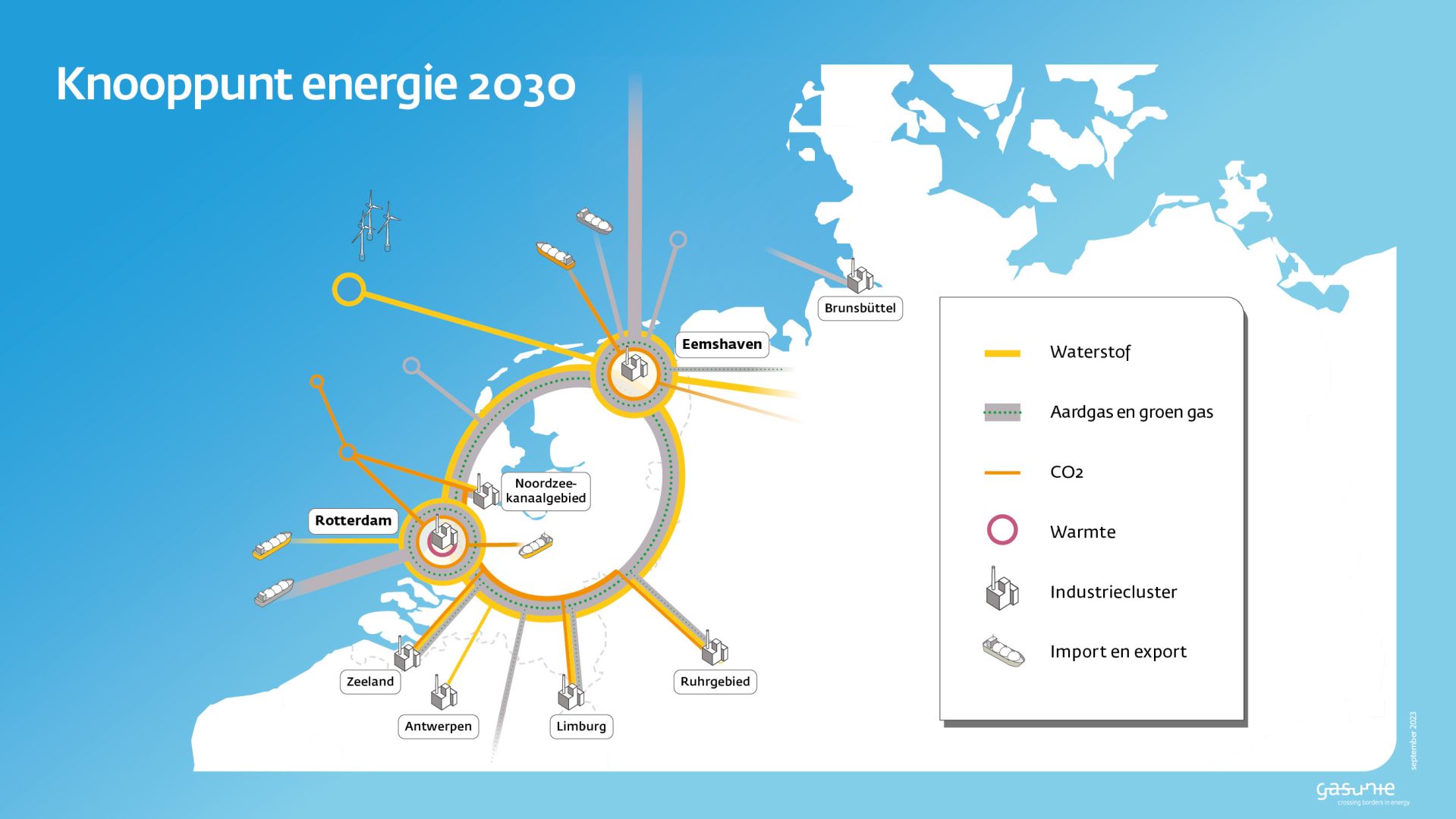
In the future, the balance of electricity on the one hand and energy molecules like hydrogen and green gas on the other will be different to how it is now. What adjustments do we need to make to our infrastructure to deal with this? Gasunie answers that question with InfraVision, a practical expansion of the future scenarios set out in the II3050 report drawn up jointly by the network companies. Gasunie Executive Board member Hans Coenen explains: ‘For the first time, we have combined all our plans into one integrated vision of molecules and of the infrastructure required to handle these. Here, it can be seen at a glance that Gasunie will be able to handle all four scenarios described in the II3050 report.’

Mix of electrons and molecules
We can sometimes tell ourselves that we have already come a long way in the Netherlands when it comes to electrification. However, around 80% of our current energy demand is for molecules, usually fossil fuels such as natural gas. The share of electricity in the energy mix will increase, likely to approximately 50% by 2050. That means molecules will still be needed for the other half. Hans says, ‘We won’t get there with wind turbines and solar farms alone. Molecules will still be important, but they must be sustainable molecules. And that’s why we should not only focus on green electricity. It’s now equally necessary to make molecules more sustainable and to do so simultaneously; otherwise it will be too late.’
Integrated development pathway
The second edition of II3050 will soon be published. This version will contain four scenarios about what our energy system might look like in 2030 and 2050. In the Netherlands, we are already working on building the sustainable energy supply chains of tomorrow: the supply chain from source to customer for hydrogen, green gas, CO2 and heat. What else is needed? InfraVision is the forward application of the findings of II3050 to the development of Gasunie’s infrastructure. ‘It is Gasunie’s social task to be able to facilitate all scenarios with our transmission and transport system,’ says Hans. ‘However, you can never know exactly what the world will look like, especially not in 2050. So, we must ensure that we have a robust infrastructure, while also being able to take action flexibly, according to the situation.’
Sustainable molecules for the Netherlands
With InfraVision, we show which adjustments to the energy system are needed to facilitate the large-scale use of sustainable energy sources. Speed, in particular, is of the essence. We cannot permit a situation to arise where citizens or companies are soon unable to offer or purchase green energy simply because the infrastructure for this is not yet available. Hans says, ‘In terms of the energy transition in the built environment, there’s not much Gasunie needs to do. Green gas has the same specifications as natural gas and we already have a very wide-spread, dense network for that. And most heat grids are developed by other parties. The hydrogen network for industry still requires a lot of work, however, including when it comes to storage.’
Hydrogen and CO₂
‘Hydrogen storage will become an important matter. The demand for hydrogen from industry will be quite stable. However, green hydrogen is produced using solar and wind energy, meaning the supply depends on the weather. That’s why we’ve been developing storage in salt caverns for some time now. A new insight is the importance of an offshore hydrogen network, where both power generation and hydrogen production take place offshore. What we don’t yet know exactly is what choices industry will make. Will they go with electrification, hydrogen or will it be carbon capture and storage? Their decisions, of course, have an effect on the required infrastructure. It’s with this in mind that we are in frequent dialogue with numerous parties to further refine our estimates.’
Green gateway to Europe
Moreover, the Netherlands is not an energy island: it is a hub that will also have to deal with incoming and outgoing energy flows in a green future. In fact, due to its favourable location, the Netherlands can play a key role in the future energy system of north-western Europe. Hydrogen for the country’s own use and to transport to countries like Germany and Belgium can be imported through the ports. The same applies to CO2, but in the opposite direction. By connecting industrial clusters in Belgium and Germany to our infrastructure, imported CO2 can be stored in empty Dutch gas fields under the North Sea. So, the Netherlands is poised to become a hub in north-western Europe for both hydrogen and CO2.
Regularly revising InfraVision
Hans says, ‘Hydrogen, CO2, green gas – we have to have sufficient infrastructure for it all, both in the Netherlands and through connections with neighbouring countries. Sufficient, but not too much either. From that perspective, Gasunie will continue to monitor which future scenarios appear to be coming true and regularly revise InfraVision. After all, you can build a large CO2 network, but if the industry opts for hydrogen and electricity, this won’t be needed. We have to keep rethinking and reassessing the situation. And then the infrastructure actually needs to be built. That’s just as complex a puzzle, if not more. What are you going to build? With whom? When does it have to be ready? The transition to the new energy system concerns a balanced collaboration between infrastructure companies, customers and the government.’
On the way to, and after the Dutch elections
Does InfraVision also play a role in the Dutch national election campaign and for the incoming Dutch government? ‘Naturally our InfraVision is input for government policy,’ says Hans. ‘This is also true of the II3050 report and analyses by TenneT, the national power grid operator. For making grants available, for example, and for reserving space. Consider the land needed for the electrolysers to make hydrogen: our vision is certainly also used when setting aside land for this. Who the voter ultimately votes for does not really matter that much in this regard: the government may shift a bit to the left or to the right, but you still need all of this to achieve the climate goals. We will have to do everything we can to achieve net zero carbon emissions by 2050.’