
The Netherlands as the heart of Europe’s CO₂ network
News article
In the presence of King Willem-Alexander, Gasunie signed an agreement with six international parties in June 2026 to jointly develop a cross-border CO2 network between the Netherlands and Germany. This development is part of a broader effort: together with its partners, Gasunie is working on several projects within a cross-border CO2 network. The network will capture CO2 emissions from European industry, transport them, and permanently store them beneath the North Sea.
European industry is facing one of the biggest challenges in recent years: carbon emissions must be reduced by 55% by 2030 compared to 1990, by 90% by 2040, and by 2050 the economy must be fully climate-neutral. For sectors such as steel, cement, chemicals and refining, this can only be achieved by using carbon capture and storage (CCS) on a large scale in addition to electrification and use of renewable hydrogen. As long as green hydrogen isn’t affordable and available everywhere, the use of blue hydrogen or CCS is the only realistic route towards climate neutrality for many industries.

The Netherlands has a favourable position for this CCS challenge. The country has a large industrial base, is on the coast and possesses dozens of depleted gas fields under the North Sea that are suitable for permanent CO2 storage. Together with its partners, Gasunie is developing a network of five interconnected projects to create a European CO2 infrastructure.
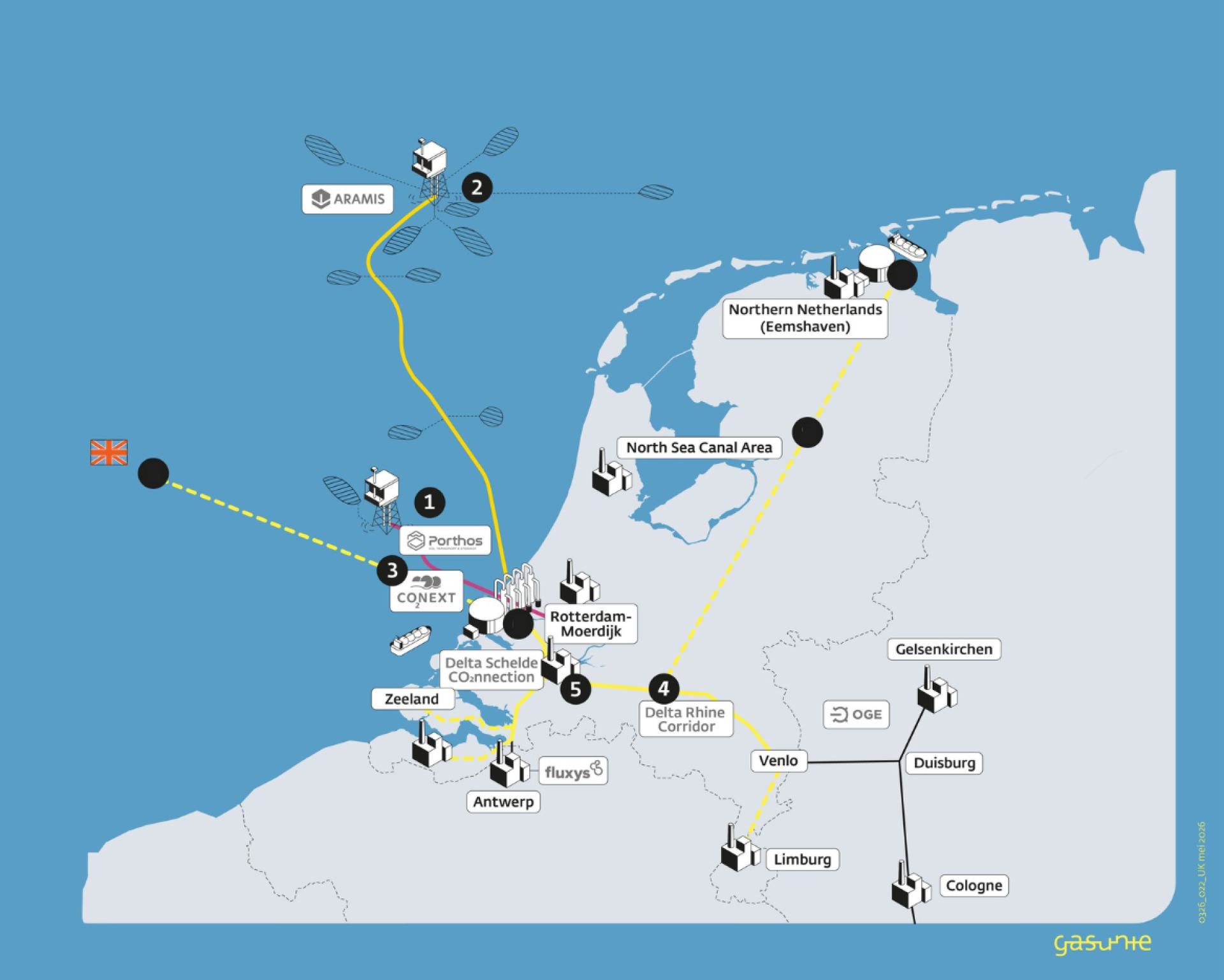
1. Porthos: the basis
The foundation for the network is Porthos, a partnership between Gasunie, the Port of Rotterdam Authority and Energie Beheer Nederland (EBN). This project focuses on the CO2 emissions of industrial companies in the port of Rotterdam. The CO2 emitted by these companies is captured, compressed and transported through a pipeline to a depleted gas field underneath the North Sea, where the greenhouse gas is stored safely and permanently. Porthos has a storage capacity of about 2.5 megatonnes per year.

The Porthos infrastructure was deliberately built larger than strictly necessary for the initial phase. The onshore pipeline has a transport capacity of 10 megatonnes per year and the compressor station can also process a volume of more than 2.5 megatonnes per year. This additional capacity is a strategic choice: Porthos was designed as the starting point for a CCS network that will grow. Given the 15-year project term, Porthos' overall storage capacity will be 37.5 megatonnes of CO2. This would significantly reduce emissions in the Rotterdam port area.
2. Aramis: the backbone
At a later stage, the Aramis project will connect to the Porthos infrastructure. This project, a partnership between Gasunie, Shell, TotalEnergies and EBN, consists of an offshore pipeline about 200 kilometres long that reaches three depleted gas fields underneath the North Sea. Aramis has a transport capacity of 22 megatonnes of CO2 per year.
Aramis and Porthos are physically connected: the Porthos compressor also feeds the Aramis pipeline. Rather than being competitors, the two projects are successive links in the same value chain. For Aramis, the aim is to get a definitive financing decision in 2027 and start operations in 2030.
3. CO₂next: the import terminal
Not all industrial companies in north-western Europe are located near a CO2 pipeline. CO2next offers a solution for them. This import terminal, a partnership between Gasunie, Vopak, Shell and TotalEnergies, allows liquefied CO2 to be supplied by ship. From the terminal, the CO2 can then be transported through the Aramis pipeline to one of the depleted gas fields deep underneath the North Sea and stored there.
This way, CO2next acts as a sea port for the CCS network: industries that cannot be connected to a pipeline on time can still make use of the storage infrastructure underneath the North Sea. CO2next and Aramis are being developed in parallel and are preparing simultaneously for a final investment decision.
4. Delta Rhine Corridor: the connection to Germany
The network doesn’t stop at the Dutch border. The Delta Rhine Corridor (DRC) will connect the industrial cluster in Rotterdam to the Ruhr area in Germany through a 200-kilometre-long CO2 pipeline. Along the way, Dutch industrial clusters will also be able to use the DRC to transport their CO2 to Aramis. This makes the system even bigger and more accessible for more industries. Gasunie is constructing the pipeline up to the border; on the German side, network operator OGE is responsible for connecting it to industry in the Ruhr area. Because of the DRC’s capacity, storage fields in the British part of the North Sea could also become accessible for CCS via this network after Aramis. The DRC will be finished by around 2033. Apart from the CO2 pipeline, the DRC will also include a hydrogen pipeline.
5. Delta Schelde CO₂nnection: the connection to Belgium
There will also be a connection towards Belgium. In addition to the DRC, work is also underway to construct the Delta Schelde CO2nnection (DSC). This connection will connect the industrial clusters in the province of Zeeland and the port of Antwerp to the Dutch CO2 network. The DSC and the DRC will link up in the Moerdijk region. At this hub, CO2 streams from the Netherlands, Germany and Belgium will merge for further transport to the Maasvlakte industrial area, after which they will be transported to the North Sea via the Aramis pipeline. The DSC is planned for 2031 or 2032.

One network, one goal
Each of these five projects is highly important, but their true strength lies in their interconnectedness. Porthos provides the physical and technical foundations. Aramis creates the offshore storage capacity. CO2next opens the network up to industries that supply CO2 by ship. The DRC and DSC bring the heaviest industrial clusters in Germany, Belgium and the central part of the Netherlands within reach of the system. Working together in a targeted manner not only means that we are creating infrastructure, we are also providing a robust value chain that our industry can rely on.
The success of this network requires guaranteed investments: from national governments and from the European Commission. Clear regulations relating to the European emissions trading system, stable subsidy programmes and clarity on cross-border CO2 transport are key prerequisites. This is the only way for us to keep European industry sustainable and competitive.
Explore the cross-border CO2 transport system here via the interactive map.